
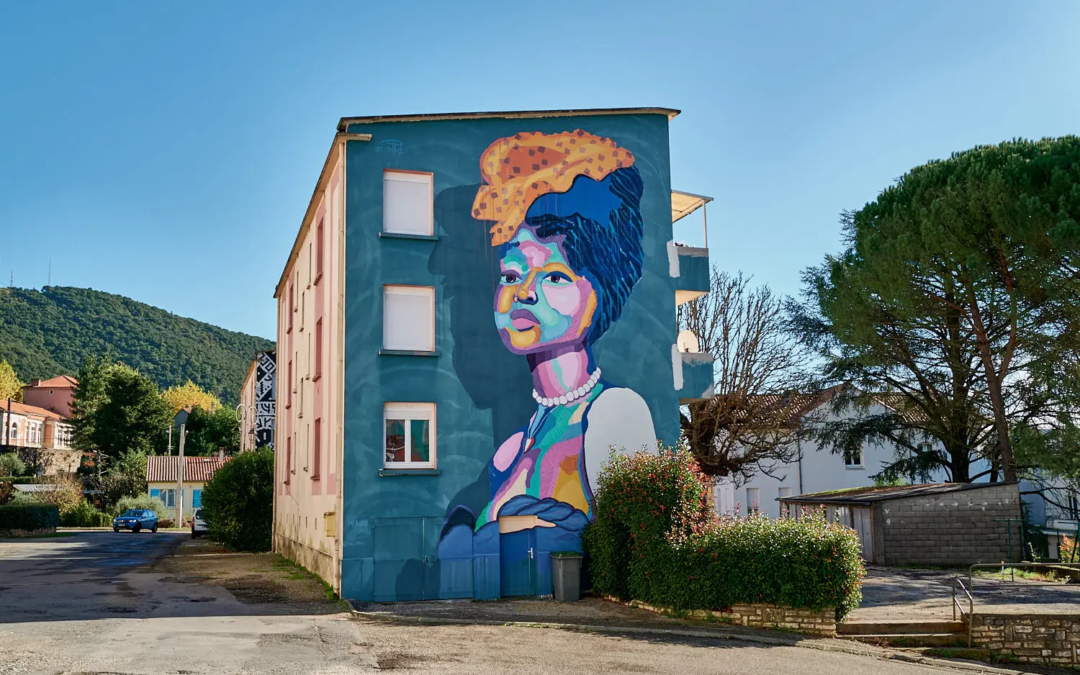
A street art photo does not only show a picture painted on a wall. It also shows the wall, street, light and neighborhood around. That's what interests me when I photograph these works. In Glasgow, a fresco can occupy the facade of a brick building. In Bessèges, a painting is discovered at the turn of a square or on a wall near an old mining town. The context is part of the photograph.
I don't paint these walls. I photograph them as I meet them, with their ladder, their materials and the signs of the place. My choice is to decide where to place me, what I leave around the work and when to start. Here are some highlights from my photographic walks in Glasgow and the Cevennes. This attention to the place joins my broader approach to urban photography, where buildings and daily uses take place within the framework.
A street art photo starts with the place
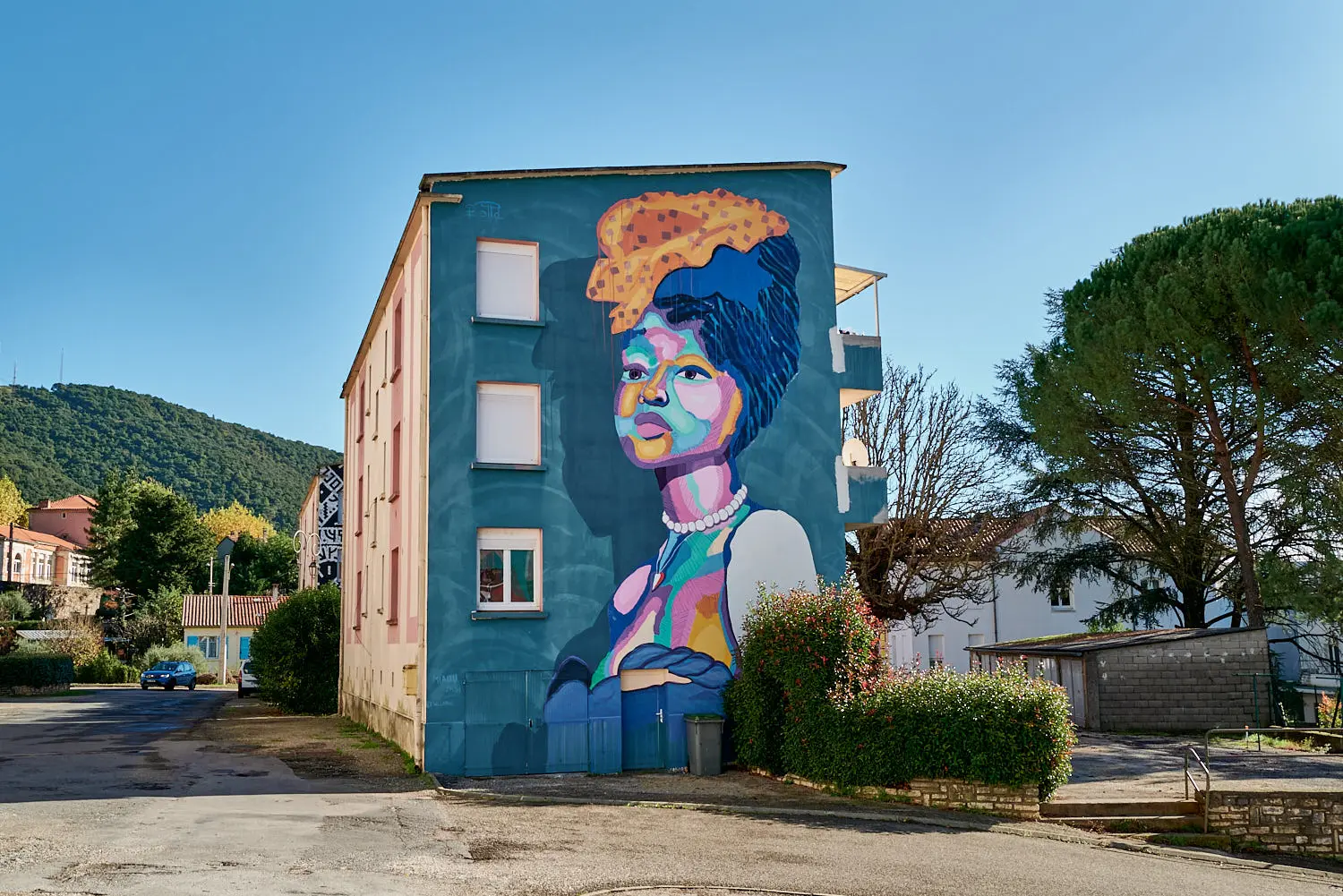
In front of a fresco, the reflex can be to approach and frame only the painting. Sometimes it's the right choice. But I start by looking around. Is it on an old facade or a recent wall? Is the street narrow or open? Is the building inhabited? Does a window cut the image? These elements change the way the fresco reads.
In Bessèges, a large painted colored woman spreads over the gable of a building. The fresco is remarkable in its colours, but the image is not limited to the portrait. The building, street, trees and reliefs in the background place it in the city. The wide format allows to see both the work and how it takes place in the neighborhood.
In Glasgow, some walls are found in passages, under bridges or near large streets. The environment is different from one work to another. A fresco in the middle of brick facades did not have the same presence as a graffiti painted in a passage space. I am therefore looking for the distance to understand the relationship between image and its support.
This first observation helps to decide the framing. If I cut all around, I turn the fresco into a pattern. If I step back, I also tell where she is. No options are neutral. I choose according to what the place gives me to see.
In Glasgow, frescoes also tell the street
During my walks in Glasgow, I walk through the streets with the camera and spot the graffiti on the walls. Some works are very visible. Others appear under a bridge or at the detour of a building. My portfolio brings together these meetings, without trying to compose a complete inventory of street art in the city.
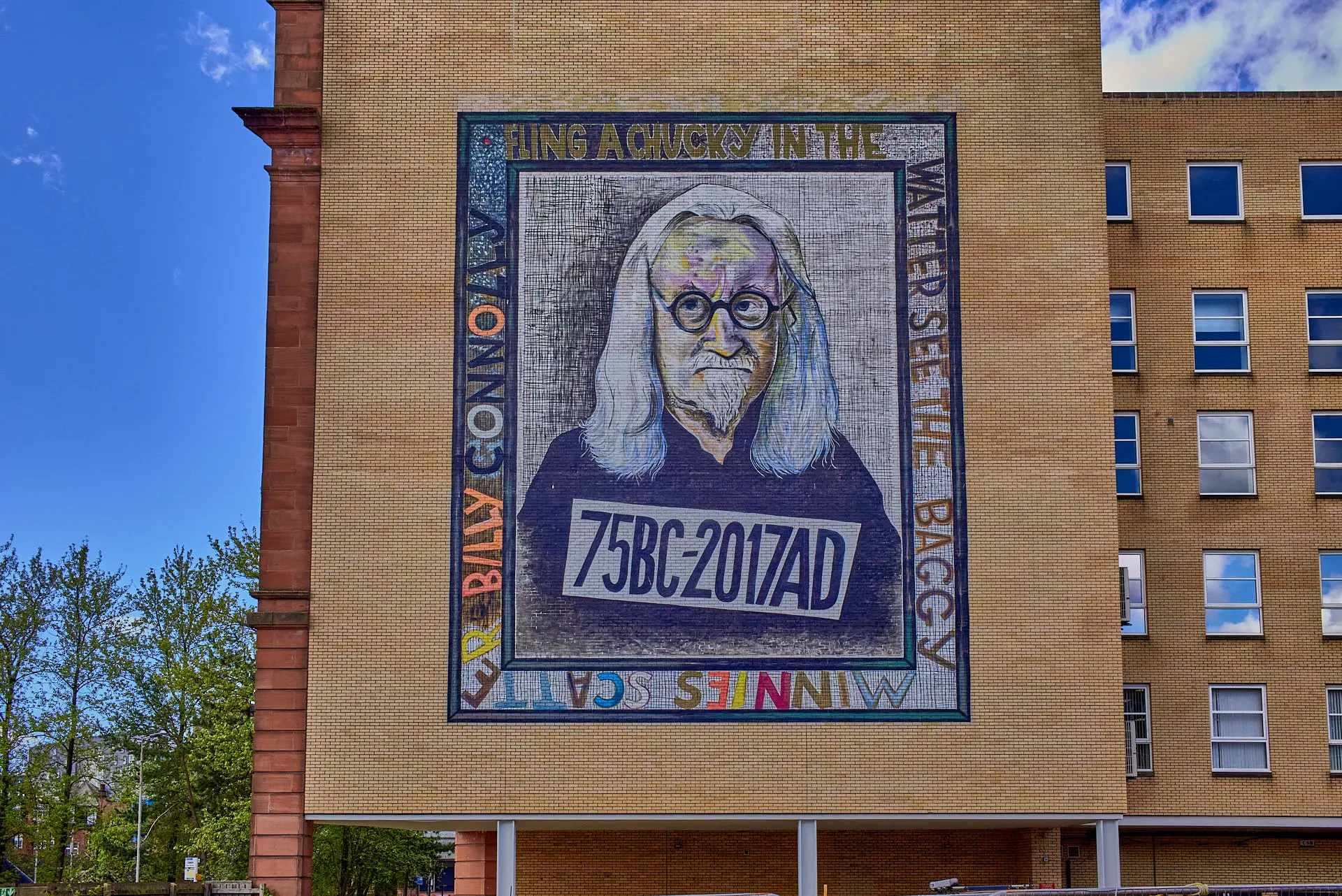
A fresco dedicated to Billy Connolly, for example, is painted on a brick facade. The portrait is large, but the wall retains a lot of space in the frame. The windows, the sky and the trees give a ladder that the tight framing would make disappear. Photography then shows a public work in its daily environment, not an isolated image of its medium.
Other images are closer to matter. A large inscription painted under a bridge occupies almost the entire frame. In this case, the letters, their contours and traces of the wall become the main subject. Sometimes I keep a little floor or ceiling to locate the work, but I do not try to force the presence of a landscape around.
These two ways of framing tell different things. The wide view gives a place to architecture and the neighborhood. The detail insists on gesture, colors and surface. I don't oppose them. I use them when each brings a clean visual information.
In Bessèges, street art is part of a local history
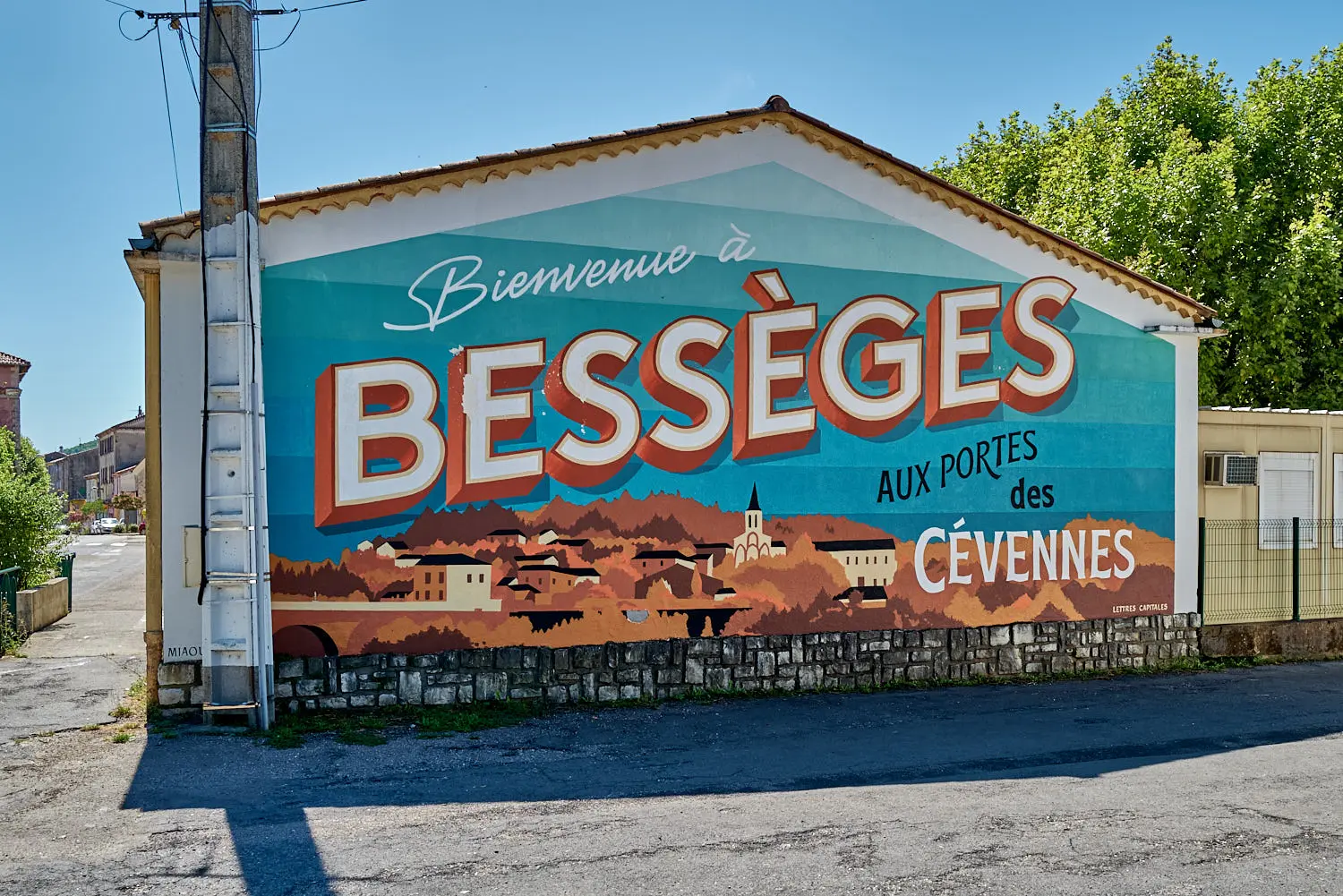
Bessèges is an ancient mining town in the Cevennes Gardoises. The walls welcome works of different styles. As I travel the city, I discover paintings in the middle of the streets and buildings that have their own stories. Street art does not arrive in a neutral setting. He dialogues with a territory marked by mining work, the transformations of the city and the lives of the inhabitants.
The page dedicated to the M.I.A.O.U. circuit in Bessèges presents several works and their locations. There is, for example, a three-storey fresco at the Lalle residence, a work of Remembrance Square, or paintings on the streets of Victor Hugo and Paul Vermale. These landmarks help to understand that the paintings are distributed throughout the city and are observed by walking.
A fresco doesn't need to be alone on a perfectly clean wall to make an image. In Bessèges, buildings, shutters, streets and vegetation are visible around the works. Sometimes I keep part of this environment in composition. This indicates the actual size of the painting and avoids giving the impression that it floats without place.
I do not claim to document all the works, nor to replace the information of artists or people who make the circuit live. My look is limited to the images I took. For artists' names, locations and visit details, it is best to consult the local sources indicated by the M.I.A.O.U. and its partners.
How I choose the framing of a fresco
I start by looking at the shape of the wall. A high gable often calls for a vertical framing or a view wide enough to maintain its relationship with the streets around it. A low work under a bridge can require a horizontal frame. I do not only decide on the format of the painting. I also look at how the building enters the picture.
I then pay attention to the elements that pass in front or around: a car, a branch, a panel, a window or a silhouette. Some of them do not read. Others give a ladder or make it clear that the fresco is a part of the daily landscape. I move a few steps before I cut. A small angle difference can prevent a roof line from cutting the subject or an object from appearing on the painting.
Light changes colors and textures. A direct sun can make a wall very contrasting. A diffuse light sometimes helps to preserve the nuances, especially on the light facades. I can't choose the weather, but I can wait a while or come back if the place allows. It also happens to accept the shadows, when they show the reliefs or record the work in a specific hour.
I mean, I check the edge of the frame. Does the wall stop in the right place? Is a window cut in a way that attracts the eye? Does the edge of the picture show the street? These details count as much as the fresco itself, because they decide the relationship between the work and its environment.
Photographing a work without owning it
To photograph street art is to photograph a work made by someone else. So I do not want to confuse the role of the photographer with that of the artist who painted the wall. When the information is known, naming the artist and situating the work makes it possible not to erase his work. When it's not, I prefer not to invent credit.
There is also a difference between showing a work on site and suggesting that it belongs to me. My images are photographs of frescoes encountered in the street. The framing and light are my choices, but painting remains the work of its author. This distinction seems important to me, especially when the image is shared online or proposed in print.
The frescoes can change, be covered or disappear. A photograph keeps track of a state of the wall at a given time, without freezing the place forever. This is one more reason to give precise benchmarks when they exist and not to present an ancient walk as a guide always up to date.
From the photographed wall to the drawing
A street art photo can also become a print. The choice of format changes the reading. A wide view keeps the fresco in its architecture. A tighter framing brings out the shapes, colors or marks of the support. Before choosing, I therefore look at what gives its meaning to the image and the distance from which it will be hung.
The paper and frame then intervene. They do not replace the work of shooting and do not change the author of the fresco. Rather, they determine how the photograph will be presented in a room. The format, password and framing options depend on each work. For benchmarks on these choices, I refer to my guide on format, pass-out and frame of a photo printand the article on the Fine Art photo print. If several prints answer in a room, here is also my method for compose a photo wall.
We can find Glasgow walls in the series Graffiti on the City, and Bessèges' paintings in the Street Art portfolio in Cévennes. These pages allow you to see other images of each walk, with more references to the works and places. If you want to compare another rendering choice, here are also my benchmarks for the street photo in black and white, from images of Bayonne.
Some questions about street art photo
What is a street art photo?
It is a photograph of an urban art work in the street, such as a fresco or a graffiti. The photographer chooses the framing and the moment, but the painting remains the work of the artist who made it.
Should we just frame the fresco?
Not necessarily. A tight framing focuses on shapes and colours. A larger view shows the building, street and scale of the work. I choose according to what the place brings to the image.
Where to see the street art photographs of Glasgow and Bessèges?
The series are visible in my portfolios dedicated to Glasgow and street art in Cevennes. The pages also give landmarks on the walls and some works photographed.
Do the prints show the original paintings?
The prints are photographs that I made of works encountered on the spot. They are not the original paintings. The features and options available are indicated on the sheet of each draw.
Walking, watching, photographing
In Glasgow and Bessèges, I'm not just looking for a nice painting. I'm looking at how she's sitting on a real street. A wall, window, passage or slope may change the reading of the fresco. The walking time also counts: some works appear only when you leave the main axis or look behind a building.
The photograph keeps a trace of this encounter, with the choices I made when setting. It does not replace the place or work of artists. It offers another way to return to these walls, to notice their colors and to see how they fit into the city.