
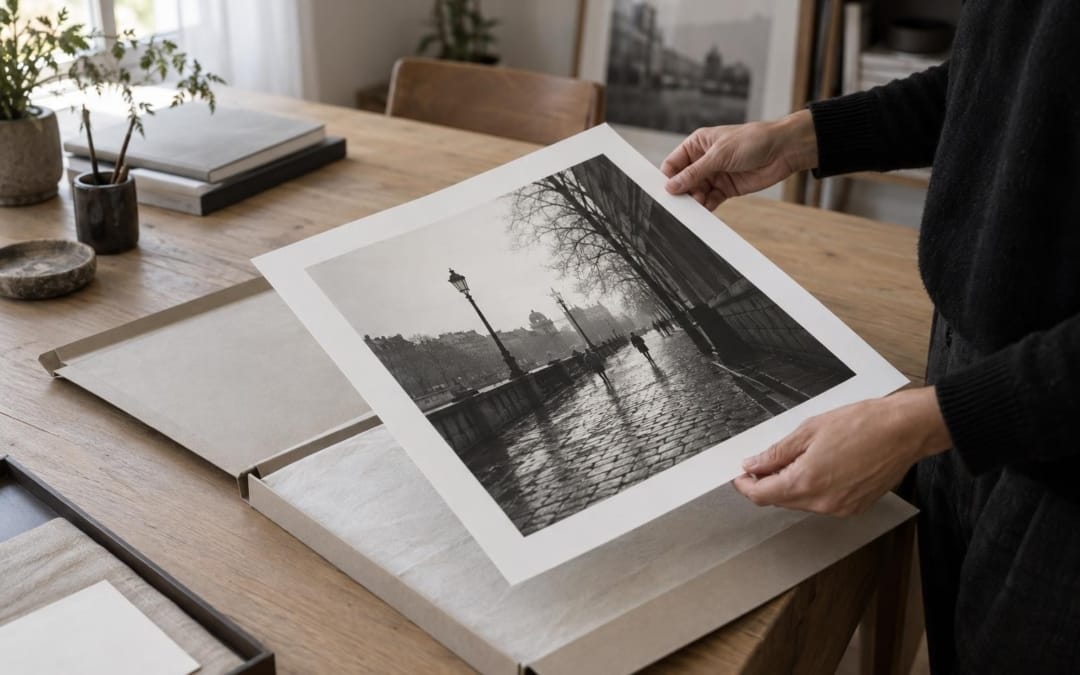
A photo print does not require a special piece to stay pleasant to watch. He especially needs to be kept away from a few simple risks: direct sun, humidity, sudden changes and awkward manipulations. When I choose an image for a wall, I first think about the light of the room and how we're going to live with it. For prints that are not watched every day, storage also counts.
Short answer to the question « How to keep a photo print? » is therefore this: hang it in a dry place, far from a sunny window and a source of heat; handle it by the edges; Place unframed prints or in a suitable pouch, without folding or stacking them under heavy objects. These precautions reduce the risk, without ensuring that an image will remain unchanged forever. Not all paper and photographic processes react in the same way.
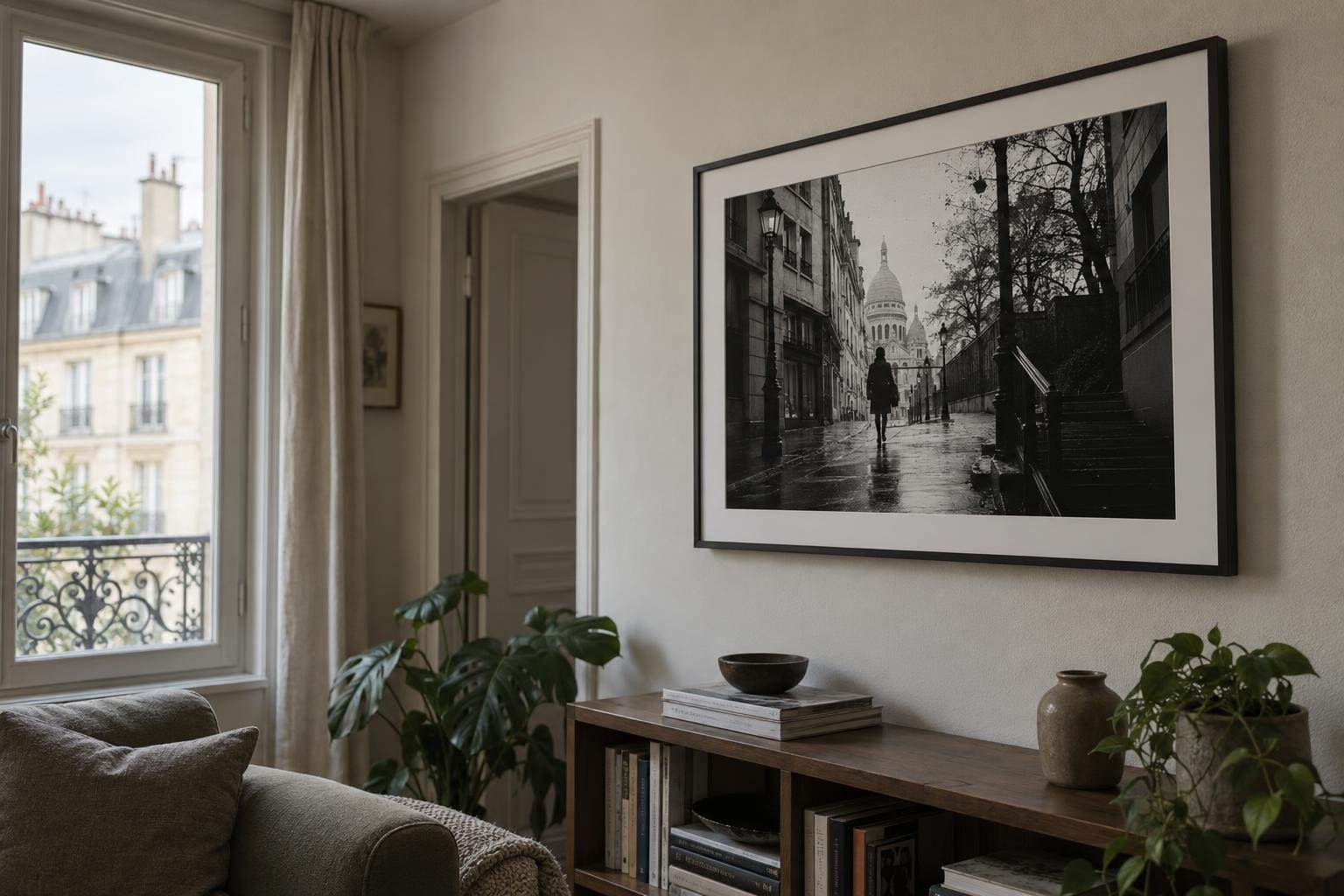
How to keep a daily photo print?
For a drawing that one wishes to exhibit, start by observing the piece at different times of the day. A wall may look in the shade in the morning and receive the sun in the late afternoon. Prolonged exposure to light may alter some photographs. The risk varies depending on the paper, inks, process and duration of exposure. It is therefore better not to place a draw where a direct radius returns every day.
Indirect light does not mean living in the dark. Rather, it is a matter of not installing the image in full sun, behind a window exposed or just next to a heat source. A stable living room, without persistent moisture, is usually a more reasonable choice than a very hot attic, a damp cellar or a location near a radiator.
I also look at what is reflected in the glass. If a window is in front of the frame, the reflections can make photography difficult to see. Lightly scrolling the image on a side wall often improves the reading comfort and also removes the drawing of direct light. My guide to choose the format, cut-out and frame of a photo print precisely addresses the choice of location and how light changes perception.
Direct light, the first risk to be limited
The light does not damage all photographs at the same speed. It would therefore be misleading to promise an identical shelf life for each draw. Ancient photographs, colour processes, digital prints and different papers have varying sensitivities. For a draw you hold, the simplest precaution remains to limit direct and prolonged exposure to the sun.
The window of a frame can reduce some risks, but it does not make the image invulnerable. It does not exempt from choosing a good location. It can also produce reflections, and the contact between image and mounting materials depends on the frame construction. If the work has historical value or is fragile, the advice of a specialist manager or restaurant will be more appropriate than a general rule.
In a house, it is not always possible to control the lighting precisely. However, you can choose a wall that does not receive the sun live, pull the curtains at the brightest hours or move the image if the exposure changes over the seasons. These simple gestures are more useful than waiting for a visible problem before acting.
Avoid moisture, high heat and unstable places
Persistent moisture can promote mould and deform paper. High heat and rapid variations are not desirable either. Avoid storing or hanging your photographs in a damp cellar, a heated attic, a garage exposed to temperature variations or near a potential leak. A dry and temperate room is a better starting point.
It is not necessary to measure humidity at home for each decorative print. On the other hand, if a room often feels enclosed, if condensation appears on the windows or if a wall remains damp, it is not a good place for a photograph on paper. Correcting the cause of moisture is preferable to adding a frame.
The U.S. National Archives site recalls that photographs are made of various processes and media, and that their conservation depends on their state and nature. His recommendations largely concern the preservation of archives, not an ordinary domestic decoration. I take them as a reminder of caution, not as a promise of life for a recent draw.
Handle a draw without marking the surface
Before moving an unframed photograph, place it on a clean and clear surface. Hold it by the edges with clean and dry hands. Avoid touching the printed surface: a pressure, fingerprint or nail may leave a mark or scratch, especially on some papers. If the draw is large, hold it with two hands instead of holding it by one corner.
Do not bend the paper into a pouch and do not attempt to straighten it by curving it in the other direction. To remove dust, avoid household products, damp cloths and window cleaners. They are not designed for the surface of a photograph. If the image is torn, swallowed or if the printed layer appears to rise, do not rub. Ask a conservation professional for advice.
The National Archives recommends to manipulate photographs by the edges and not to touch the image area. For a fragile or old photograph, their recommendations are more detailed and take into account the process. The common sense for a decorative drawing remains simple: to manipulate it as little as possible, with care, and not to try to repair yourself a serious damage.
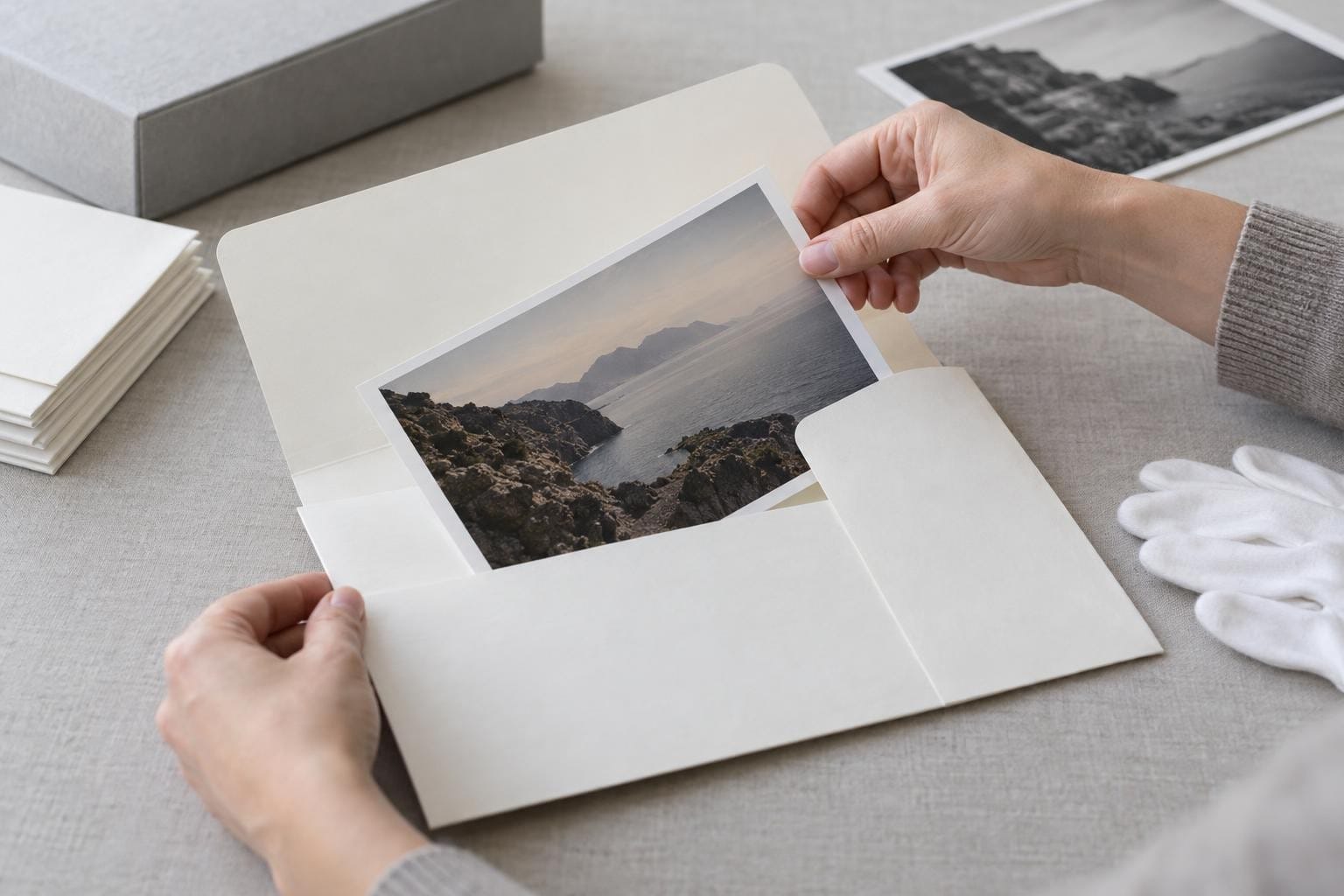
Sort prints that are not hung
For an unframed print, choose a clean, dry and sheltered place from light. A pouch or folder designed for photographs is preferable to any sheet of paper, a dirty envelope or a plastic whose composition is unknown. Archive organizations recommend suitable conservation materials, including acid-free and lignin-free. These criteria are especially useful for images that one wishes to keep for a long time or consult regularly.
Ideally place one draw per pouch so that the surfaces do not rub against each other. A clean and rigid box can then protect the pouches from dust and shock. Set it flat if the format and support allow. Do not place heavy objects on it and avoid filling the box to the point of compressing the images.
If the draw is already framed, avoid putting it face to face against an abrasive surface. When travelling, protect the corners and keep the whole in the shelter of water. For a large transport or work of high value, packaging depends on the format, state and frame. Improvised packaging can do more damage than it avoids.
The frame helps to present the image, but does not replace the correct location
A frame reduces direct contact with dust and fingers. A well chosen pass-out can also keep the image away from the glazing, depending on how the frame is mounted. But the frame does not automatically protect against moisture, shock or prolonged sun exposure. It is therefore necessary to first choose the wall, then check that the assembly is suitable for drawing.
Mounting materials are important for long-term preservation. Direct contact with inappropriate cardboards or glues can be a problem, especially for an ancient or precious work. For a recent decorative print, follow the instructions provided with the product and ask a framer for advice if you have any doubts about the installation. For a heritage photograph, use a specialist rather than dismantling an old frame.
The format, pass-out and frame options may vary depending on my store's prints. The characteristics of a work should not be applied to the entire collection. To understand the presentation possibilities, you can read the guide on framed photo print and consult information about the chosen photograph. To better understand the proposed medium and Fine Art vocabulary, I also detail the criteria for Fine Art photo print.
What it's best to avoid
- The direct sun on the image. Change the location if the radius returns to the frame regularly.
- The damp or very warm rooms. Avoid cellar, attic, garage and wall close to a leak.
- Fingers on the printed surface. Hold the draw by the edges and support it properly.
- Water or household cleaning. These products are not intended for a photographic surface.
- Adhesives directly on paper. Do not use adhesive tape or glue to attach a draw to a wall or pouch.
- Bulk storage. Avoid images rubbing, bend or being crushed under objects.
- Improvised repairs. A tear, mould or emulsion that snails requires specialized advice.
A simple routine to take care of its prints
When I prepare an image to hang it, I first check the light at the intended place. I look at the wall in the morning and later in the day. I make sure that it is not exposed to moisture or a source of heat. Then I choose the frame according to the image and the room, without assuming that the glazing is enough to protect everything.
For a draw that stays tidy, I prepare a clean pouch before handling it. I release the table, I take the image through the edges and I put it away without folding it. Finally, I note the subject and date on the cover, rather than writing on the photograph. These actions take little time and avoid several common accidents.
Preservation always depends on precise printing, process, paper, condition and environment. For an old, fragile or irreplaceable photograph, these domestic advices do not replace the advice of a restaurant. For an image that we simply want to expose at home, limiting direct sun, humidity and sudden manipulation is already a good start.
To go further
The Ministry of Culture recalls that packaging can protect the photographic background from dust, light, shocks and environmental variations. The U.S. National Archives details the handling and storage precautions for photographs, with recommendations that vary by process and medium. These resources relate to conservation and archives, they do not guarantee a precise lifetime for a domestic print run.